In short: The NDIS does not keep a list of approved beds, brands or models. It funds an adjustable bed when the bed relates to your disability, is reasonable and necessary, and is an NDIS support. Beds count as higher-risk assistive technology, so an occupational therapist (OT) or other assistive technology advisor should recommend the bed first. The higher the cost, the more evidence the NDIS needs.
Search for an NDIS bed and almost every result says “NDIS approved”. On Australian forums and review sites, families describe the same frustration: a shop says a bed is approved, the plan says something else, and an OT report that took months still ends in a knock-back. Here is how the decision is actually made.
Is there a list of NDIS approved beds?
No. When a website calls a bed “NDIS approved”, it usually means one of two things. Either the seller is a registered NDIS provider, or the bed is a type of equipment the NDIS can fund when the rules are met. Neither means the NDIS will fund that bed for you.
The NDIS bases each assistive technology decision on:
- your disability-specific needs
- your goals
- the evidence that supports the request
- whether another source should fund it instead
So the useful question is not “Which beds are approved?” It is “What evidence shows this bed meets my needs?”
Why the NDIS treats beds as higher-risk equipment
The NDIS generally treats items regulated by the Therapeutic Goods Administration (TGA) as higher-risk. Its own examples include wheelchairs, beds and bed sticks. For these, get advice from an assistive technology advisor or assessor before you buy, even when the price is low.
There is a practical reason too. A care bed has motors, moving sections and often rails. The wrong height range, a mattress that does not suit the frame, or a gap beside a rail can create new risks. An OT checks the bed against the person, the carer and the room.
What evidence an NDIS adjustable bed needs at each cost level
The NDIS sorts assistive technology by the price of each item. As at 19 November 2026 the levels are:
- Low cost, under $1,500: usually paid from your consumables budget with no approval step. Because beds and bed sticks are higher-risk, still get advice first.
- Mid cost, $1,500 to $15,000: written advice from an allied health practitioner or other assistive technology advisor. A letter, email or report is enough. It should say what type of equipment you need, why it is the best value for your disability support needs, how it helps with the goals in your plan, and roughly what it costs. Paid from capital supports.
- High cost, over $15,000: an assessment report from a qualified assistive technology assessor, plus a quote that covers delivery, installation and training. Paid from capital supports.
Ask your OT which level the recommended bed, mattress and rails fall into together, because that decides the evidence you need.
What your OT looks at when recommending a bed
A strong report links each feature of the bed to a daily task. Common features, and the needs they answer:
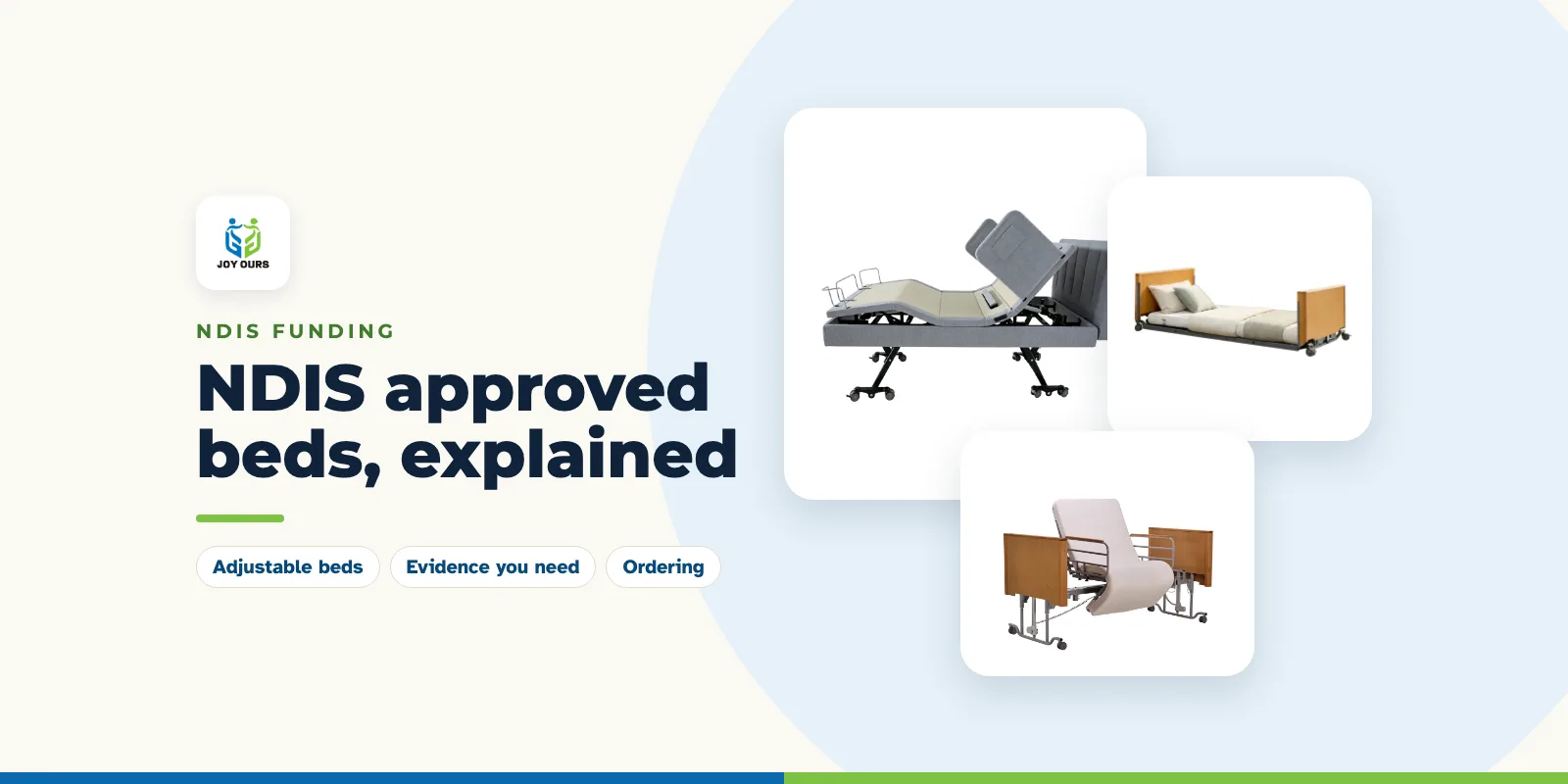
- Height adjustment (hi-lo). Low for sitting down and standing up safely, higher so a carer can help without bending. The Enjoycare N931-Y Hi-Lo Homecare Bed adjusts the whole bed height and has back, leg and lumbar adjustment with preset positions.
- Back and knee profiling. Sitting up to eat, read or get ready to stand, without a stack of pillows that keeps sliding.
- A low or floorline height. For people at risk of rolling or falling out of bed. The Flexi Floorline Bed and the CB12 Floorline Bed lower close to the floor.
- A rotating bed. For people who struggle to swing their legs out of bed. The Cobalt Rotating Bed turns to a chair-style position to help with getting in and out.
- The mattress. A pressure care mattress where skin is at risk. See pressure care mattresses and our guide to pressure injury stages and equipment.
- Rails and handles. A side rail or bed stick chosen to fit the bed, such as the iCare Bed U-Assist Side Rail for iCare homecare beds.
Our guide to hospital beds for home compares hi-lo, adjustable and low beds in more detail.
Why NDIS bed requests get knocked back
These are the gaps that most often stop a request:
- The evidence describes a diagnosis, not a daily problem. “Has MS” is not enough. “Cannot sit up in bed without help; her carer lifts her twice a night” is.
- The bed reads as furniture. Everyday household furniture is not an NDIS support, so an adjustable “lifestyle” bed chosen for comfort alone is hard to justify.
- A cheaper option would do the job. The NDIS generally funds the most cost-effective option that meets the need, so the report should explain why simpler options were ruled out.
- The bed is in the wrong budget. Funding for mid and high cost assistive technology is usually a stated support, so the bed must match what your plan describes.
- Another system should pay. Short-term equipment after a hospital stay, for example, may come from the health system.
If you get a knock-back, ask for the written reasons. They tell your OT exactly what evidence is missing.
Who you can buy an NDIS bed from
If your assistive technology funding is NDIA-managed, you must buy from a registered NDIS provider. If it is plan-managed or self-managed, you can buy from any supplier. Joy Ours is a registered NDIS provider (No. 4053607206), so we can supply under all three. Our NDIS page explains where the invoice goes for each plan type, and our guide to NDIS assistive technology covers the rules in full.
Renting a bed while you wait
The NDIS says renting can be the better choice when your needs are likely to change. It can also bridge the gap while evidence is gathered or approval is pending. We offer equipment hire for a minimum of two weeks, and depending on the equipment and your plan, NDIS funding may be used for hire.
How to order an NDIS bed with Joy Ours
- Send us the OT report or recommendation through our quotes from OT reports service, or email info@joyours.com.au.
- We send a formal quote for the bed, mattress and accessories the report names.
- You, your plan manager or your OT send the quote and evidence to the NDIS where approval is needed.
- Once funding is in place, we deliver, set up the bed and show you and your carers how it works.
You can see beds in our Melbourne and Adelaide showrooms, or browse electric adjustable beds.
Frequently asked questions
Does the NDIS pay for adjustable beds?
It can. Powered adjustable beds are one of the NDIS's own examples of assistive technology. The bed must relate to your disability, be reasonable and necessary, and be backed by evidence that suits its cost and risk.
What is the difference between a care bed and an adjustable lifestyle bed?
A homecare bed is built for daily care: height adjustment for transfers, profiling sections, rails that fit the frame and a mattress matched to the bed. A lifestyle bed is designed mainly for comfort. The NDIS funds what meets a disability-related need, so the report should say which care features are needed and why.
Can I buy a bed from my NDIS consumables budget?
Only a low-cost item, and even then beds and bed sticks count as higher-risk, so get advice first. Most care beds are mid or high cost and are paid from capital supports.
Do I need an OT report for an NDIS bed?
For a mid-cost bed you need written advice from an allied health practitioner or assistive technology advisor. For a high-cost bed you need an assessment report and a quote. An OT is the most common advisor for beds.
Does the NDIS fund pressure care mattresses?
A pressure care mattress is assistive technology too, so the same rules apply: it must meet a disability-related need, and the evidence depends on its cost and risk.
Can I choose the brand of bed?
You can ask for a particular bed, but the NDIS funds what the evidence supports, generally the most cost-effective option that meets the need. Ask your OT to name the features you need, not only a model, so there is more than one suitable choice.
Sources
- NDIS: What is assistive technology
- NDIS: How to buy mid-cost or high-cost assistive technology
- NDIS: What are NDIS supports
Sources checked on 19 November 2026. Scheme rules and product details change, so check the official pages before you decide.
Questions about this?
Our team is happy to help — by phone, email or in a showroom.