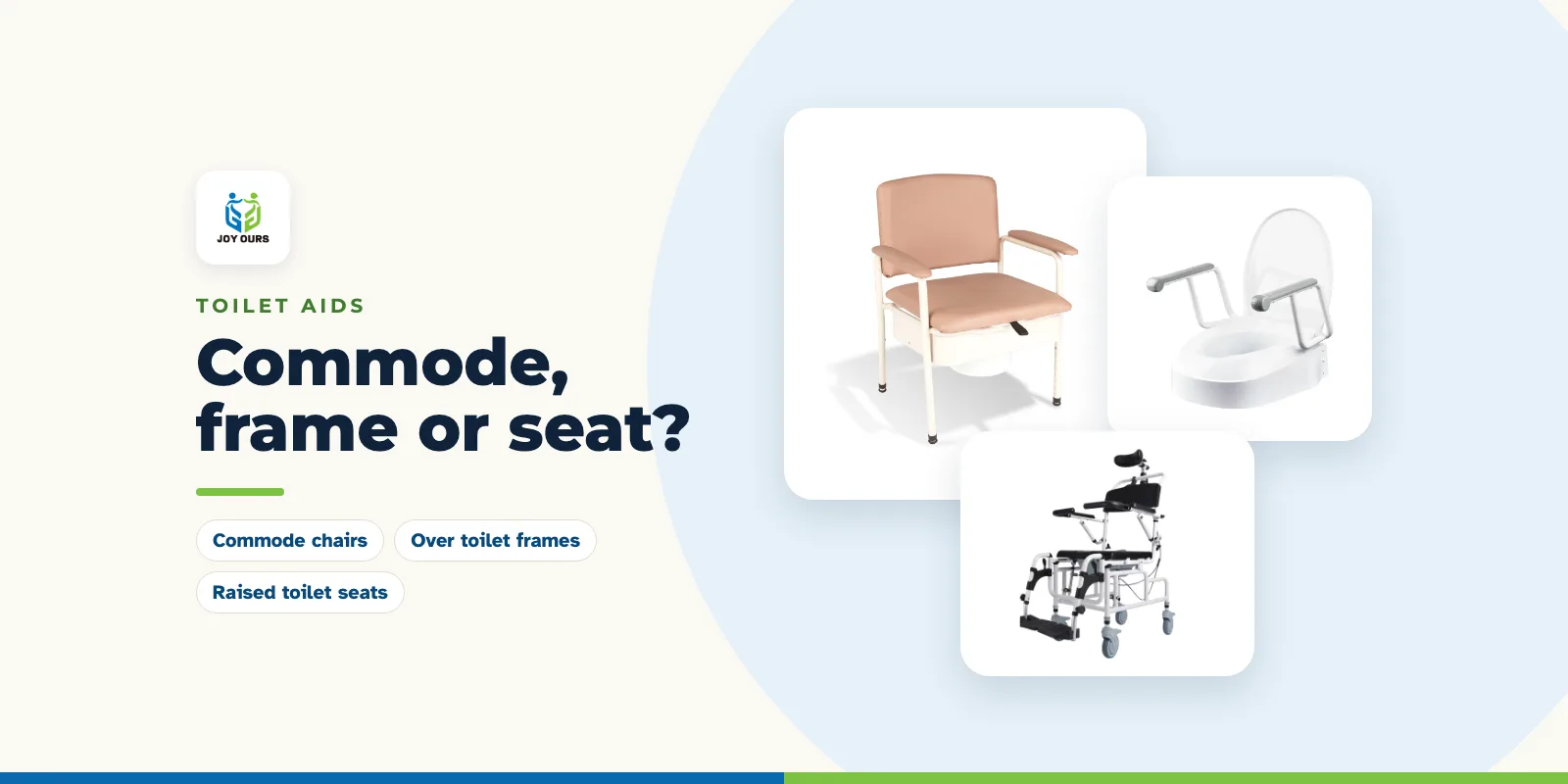
In short: A raised toilet seat, also called a toilet seat raiser, makes your own toilet higher. An over toilet frame adds height and armrests, and many fold away or double as a bedside commode. A toilet surround or toilet support arms give you something solid to push up from without raising the seat. A commode chair is a separate toilet for when getting to the bathroom is the problem: beside the bed at night, or wheeled over the toilet and into the shower.
The toilet is one of the first places daily life gets harder, and one of the least talked about. Families usually notice it the same way: Mum takes longer to stand up, grabs the towel rail or the basin, or starts dreading the trip to the toilet at night. The right toilet aid depends on which part has become hard.
Start with one question: getting on and off, or getting there?
- Sitting down and standing up is hard: add height, armrests or both to the toilet you already have.
- Getting to the toilet is hard, especially at night: a bedside commode brings the toilet to the person.
- The toilet and the shower are both hard: a shower commode on castors can do both jobs with one transfer.
Toilet aids compared
Raised toilet seat (toilet seat raiser)
A moulded seat that sits on the toilet bowl and adds height, so there is less distance to lower yourself and push back up. Most come in a few heights. The Savanah Raised Toilet Seat comes in three heights, with or without a lid. The Homecraft Raised Toilet Seat with Armrests comes in 6, 10 and 15 cm heights and adds lift-up armrests.
- Often suits: people who can stand with a little effort but find a standard toilet too low.
- Keep in mind: it must suit your toilet bowl and be attached securely. A seat that shifts is a fall risk.
Browse all raised toilet seats.
Over toilet frame (over toilet aid)
A free-standing frame with a seat and two armrests that stands over the toilet, with legs that adjust for height. Many fold for storage or travel, and with a pan or bucket and lid, many can also be used beside the bed as a commode. The Homecraft Aluminium Folding Over Toilet Aid folds, and can be used over the toilet, as a commode or as a shower chair. It is sold without the bucket and lid.
- Often suits: people who need both extra height and armrests to push up from.
- Keep in mind: all four legs must sit on an even floor at the same height. See the safety checks below.
Browse all toilet frames.
Toilet surround or toilet support arms
Handles on both sides of the toilet that do not change the seat height. The Enjoycare JOV008 Toilet Surround adjusts in height and width, with retractable handrails and an LED light for night-time. Liberty Toilet Support Arms fit onto compatible toilets, fold up when not in use and can be removed, which suits rentals. The Avail Toilet Support Fold Up Frame clamps to the toilet pan and has coloured contact points that are easier to see.
- Often suits: people whose toilet height is fine but who need something solid to hold.
- Keep in mind: if you own your home, fixed grab rails may be the longer-term answer. Our guide to accessible bathroom modifications explains the options.
Bedside commode
A chair with a toilet seat and a removable pan, used beside the bed. The Hero Medical Deluxe Bedside Commode has a padded seat and backrest, a removable pan and adjustable height. See all bedside commodes.
- Often suits: night-time toileting, or anyone who cannot safely walk to the bathroom.
- Keep in mind: place it where it can be reached from the bed, with a light on and nothing to trip over. Someone also has to empty and clean the pan.
Shower commode (mobile commode)
A commode chair made for wet areas, on lockable castors. It can be wheeled over the toilet and into a step-free shower, so one transfer covers both. The Pinnacle Deluxe Shower Commode comes in attendant-propelled and self-propelled models. The Enjoycare EW7903 Reclining Mobile Shower Commode adds a reclining backrest and swing-away armrests for people who need more support. See all shower commodes.
- Often suits: people who need a carer's help with toileting and showering.
- Keep in mind: you need a step-free shower and room to turn the chair. An OT usually recommends the model.
Bedpans and urinals
For when getting out of bed is not possible or not safe. The Homecraft General Purpose Bedpan has a built-in handle for carrying and emptying. See urinals and bedpans.
How high should a raised toilet seat be?
The right height depends on the person and the toilet, so there is no single answer. An occupational therapist (OT) usually measures the person's lower leg and the toilet, then picks a seat or frame height that lets them sit and stand with their feet flat on the floor. A seat that is too high can be as hard to use as one that is too low, so if you are unsure, ask for a home trial before you buy.
Safety checks before the first use
St Vincent's Hospital Melbourne's guide to over toilet frames and Dementia Australia's continence advice cover the basics:
- Check the height-adjusting buttons are locked in place and all four legs sit on an even surface.
- Line the frame's seat up with the rim of the toilet bowl.
- If you use a splashguard, make sure it does not touch the bowl. You may need to raise the frame.
- Remove floor mats and anything else you could trip on.
- To sit, stand with the backs of your legs against the frame and hold both armrests. To stand, push up from both armrests.
- Use a night light or a motion sensor light for night-time trips, and keep walking aids within reach.
- Lock a commode's castors before every transfer, and check the safe working load against the user's weight.
- Check fittings regularly, and stop using anything that wobbles or looks damaged.
Will Support at Home or the NDIS pay for toilet aids?
Support at Home: toilet aids are on the government's AT-HM list. Toilet seats and bedpans are listed as low risk. Commode chairs without castors are listed as “under advice”. Commode chairs with castors, raised toilet seats and toilet arm supports have a prescription recommended. Your provider arranges the item, and an OT where a prescription is needed. See our Support at Home page.
NDIS: low-cost, low-risk items can usually be bought from your consumables budget. Get advice first for higher-risk items. See our NDIS page.
Try before you decide
We offer free home trials on selected equipment and can quote straight from your OT's report. Visit our Melbourne or Adelaide showroom, or browse all toilet aids.
Frequently asked questions
What is a commode?
A commode is a chair with a toilet seat and a removable pan or bucket. A bedside commode stays beside the bed for night-time use. A shower or mobile commode has castors so it can be wheeled over the toilet and into the shower.
Can an over toilet frame be used as a commode?
Many can, once a pan or bucket and lid are fitted. Check the listing, because some frames are sold without them.
Raised toilet seat or over toilet frame: which is better?
A raised toilet seat is compact and only adds height. An over toilet frame adds height and armrests to push up from, and many fold away. If standing up needs your arms, a frame or a raised seat with armrests usually helps more than height alone.
Can I use a commode in the shower?
Use a commode made for wet areas, such as a shower commode. Check the product instructions before using any commode in the shower.
Do I need an OT to choose a toilet aid?
Not always for a simple raised seat. An OT is recommended for frames, commodes and shower commodes, and funding schemes often expect a prescription for them.
Does Support at Home cover a toilet seat raiser?
Raised toilet seats are on the AT-HM list, with a prescription recommended. Your Support at Home provider arranges it once your aged care assessment approves AT-HM funding.
Sources
- My Aged Care: Assistive Technology and Home Modifications (AT-HM) scheme
- Department of Health, Disability and Ageing: AT-HM list (last updated 17 July 2026)
- St Vincent's Hospital Melbourne: Over toilet frame, a guide for patients and their carers
- Dementia Australia: Continence
Sources checked on 19 November 2026. Scheme rules and product details change, so check the official pages before you decide.
Questions about this?
Our team is happy to help — by phone, email or in a showroom.